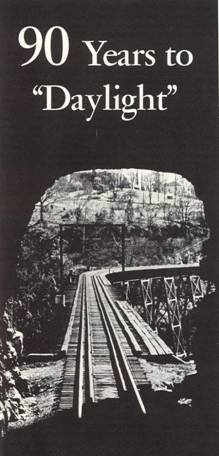
 When all tunnel clearance restrictions were removed for all time on The
It was the
culmination of 90 years of tunnel work on this heavily traveled line and
foretold a decent burial for the old nickname "rathole
division."
That nickname
once aptly characterized the middle section of the
When the City
of
The first
construction contract called for the excavation of
Six years
later on
Tunnels were
numbered 1 through 27 (running from north to south). They ranged in length from
3,992 feet (
Tunnel
openings were designed to be approximately 15* feet wide and 20 feet high at
the top of the arch. Some of the arches appeared almost round, some resembled
flat topped triangles, others were more jagged in
appearance. The blasting techniques of the 1870's left something to be desired.
Some of the
tunnels had been bored through solid limestone or sandstone and would never
need lining. Tunnels in softer formations of rock, clay and shale were for the
most part lined with heavy timbers for temporary protection but were intended
to be relined with masonry. Even 12 inch by 12 inch timber supports and 3 inch
and 6 inch thick planking would soon deteriorate in the tunnel dampness.
By the end of 1884, two tunnels had been completely lined with brick and
stone and five others had partly finished interiors a total of almost 4,500
feet. The next eight years, saw supporting masonry installed in another 11,000
feet of tuneling. By the time tunnel work came to a
temporary halt in early 1893 (the
Four tunnels remained to be arched, but the engineers decided to get rid
of two of them permanently instead. Tunnel No.6, the line's
shortest at 189 feet, was "daylighted" into
an open cut in 1901. A masonry lining proved impractical for tunnel No.27
(1,941 feet long and cut through clay, boulders, limestone and shale) so a new
line to bypass the tunnel was completed in 1902 and placed in service in 1904.
Lining of the two remaining tunnels (in 1902) completed all the tunnel masonry
required by the lease.
Two more short tunnels were eliminated in 1907. Tunnel No.10 ( 270 feet) was "daylighted"
into an open cut and tunnel No.19 ( 360 feet) was bypassed by a line change. Four down and 23 to go.
Double tracking of parts of the
Trains thundered through the tunnels for almost a decade before the next
abandonment about 1930. This was tunnel No.1 and it too was bypassed as a
result of installing double track, this time near
When the federal government planned Wolf Creek Dam on the Cumberland
River in Kentucky in the late 1940's it was apparent that the high water level
in the new reservoir would be some 20 feet above the rails on Southern's existing bridge. Unless the railway planned to
swap its diesels for submarines, a new and higher bridge was in order.
In constructing the new bridge, the builders relocated the line to bring
it to the north bank of the
Tunnel No.16 near
As the 1950's drew to a close, only 13 of the original tunnels remained
. . . but these saddled increasing restrictions on modern railroad operation.
Tunnel openings that had seemed so roomy in 1881 applied an unwelcome
clearance "squeeze" to the big, high capacity cars and high, wide
loads that were helping create savings for shippers and greater traffic volume
for the railroad the freight on which jobs depend. Even one small bore tunnel
was too many on the busy
In 1961 work began on the abandonment or enlarging of all the remaining
tunnels on the line. Eighteen months and $32 million later, the "rathole division" had lost its old nickname for good.
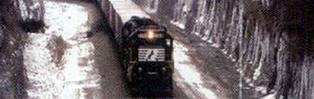
Nine tunnels were bypassed outright by line changes - Nos. 2, 5, 7, 8,
9, 11, 12, 15 and 23. Tunnel No 2 at
.
Three of the former tunnels (Nos. 22, 24 and 26) were bypassed through
new tunnels, but these have openings twice as large as the old 20 feet wide and
30 feet high at the top of the arch. Tunnel No.25, the one remaining relic of
the original tunnel work on the